Twickenham is one of the oldest residential neighborhoods in Alabama. Five Points and Blossomwood followed in the 1920s–1960s. The historic homes here are part of what makes these neighborhoods worth living in — original craftsman details, wide front porches, mature tree canopy. They’re also homes where the plumbing was installed before anyone knew lead solder was a problem.
Huntsville Utilities completed its Lead Service Line Inventory in 2024 and confirmed zero lead service lines on the utility side of the meter — that’s good news. But the utility’s responsibility ends at the meter. The pipes inside your walls, the solder at every joint in your copper plumbing, the brass fittings at your faucets — those are yours. And if your home was built before 1986, there’s a real possibility some of that infrastructure contains lead.
The Safe Drinking Water Act amendments banned lead solder in residential plumbing in 1986. Most of Twickenham was built between the 1880s and 1940s. Five Points spans the 1920s–1960s. Blossomwood is predominantly 1930s–1960s. If your home falls in this range and has original copper plumbing, the solder at your pipe joints likely contains lead. The only way to know what’s coming out of your tap is to test it.
The Three Water Concerns for Historic Huntsville Homes
1. Lead from Internal Plumbing
This is the concern specific to historic neighborhoods that doesn’t affect newer Huntsville subdivisions. Lead doesn’t come from the Tennessee River or the limestone aquifer — it comes from the pipes inside older homes. When water sits in contact with lead solder overnight, it absorbs trace amounts of lead. The first draw in the morning — the water that sat in your pipes all night — will have the highest lead concentration. Running the tap for 30–60 seconds before drinking reduces exposure, but doesn’t eliminate it.
No amount of lead in drinking water is considered safe by the EPA or CDC. Children under six and pregnant women are at highest risk. If you live in a pre-1986 Twickenham, Five Points, or Blossomwood home and have never tested your tap water, testing is the right first step before making any treatment decisions.
2. PFAS from Huntsville Utilities
This concern applies to every Huntsville Utilities customer regardless of neighborhood. The utility’s 2025 Consumer Confidence Report shows total PFAS at 22.5 ppt, with PFOS reaching 7.6 ppt and PFOA reaching 4.2 ppt — both above the EPA’s 4 ppt MCL. PFAS comes from upstream Tennessee River contamination, not from your home’s plumbing. An under-sink reverse osmosis system removes PFAS at the drinking tap regardless of where your home was built.
3. Chloramine — Not Chlorine
Huntsville Utilities switched from chlorine to chloramine disinfection in 2021. For historic home owners, this matters for one specific reason: chloramine is more aggressive toward plumbing materials than chlorine. Long-term chloramine exposure can cause pitting and accelerated corrosion in older copper pipes and lead solder joints, which can increase lead leaching over time. This is one reason testing — not just filtering — is the recommended first step for homes with original plumbing.
By Neighborhood — What to Expect
The Lead Pipe Timeline — Why 1986 Is the Line
Lead solder (50% lead, 50% tin) standard in residential copper plumbing. All of historic Twickenham and most of Five Points built in this era. Lead leaches from solder joints, especially in the first draw of the day after water sits overnight.
Safe Drinking Water Act amendments banned lead solder and required lead-free fixtures. “Lead-free” in 1986 still allowed up to 8% lead in fixtures — not zero. Homes built 1986–2014 may still have trace lead in fittings.
Revised definition of “lead-free” reduced allowable lead content in fixtures to 0.25%. Homes built or replumbed after 2014 have the lowest lead risk from internal plumbing.
Huntsville Utilities completes Lead Service Line Inventory — confirms zero lead service lines on the utility side. The utility side is clean; the homeowner side depends on your home’s specific plumbing history.
Step 1 — Test Your Tap Water First
Before buying any filter, know what you’re filtering. A test designed specifically for older homes on city water gives you actual ppb readings for lead, copper, iron, and 46 other analytes — not a yes/no strip test result.
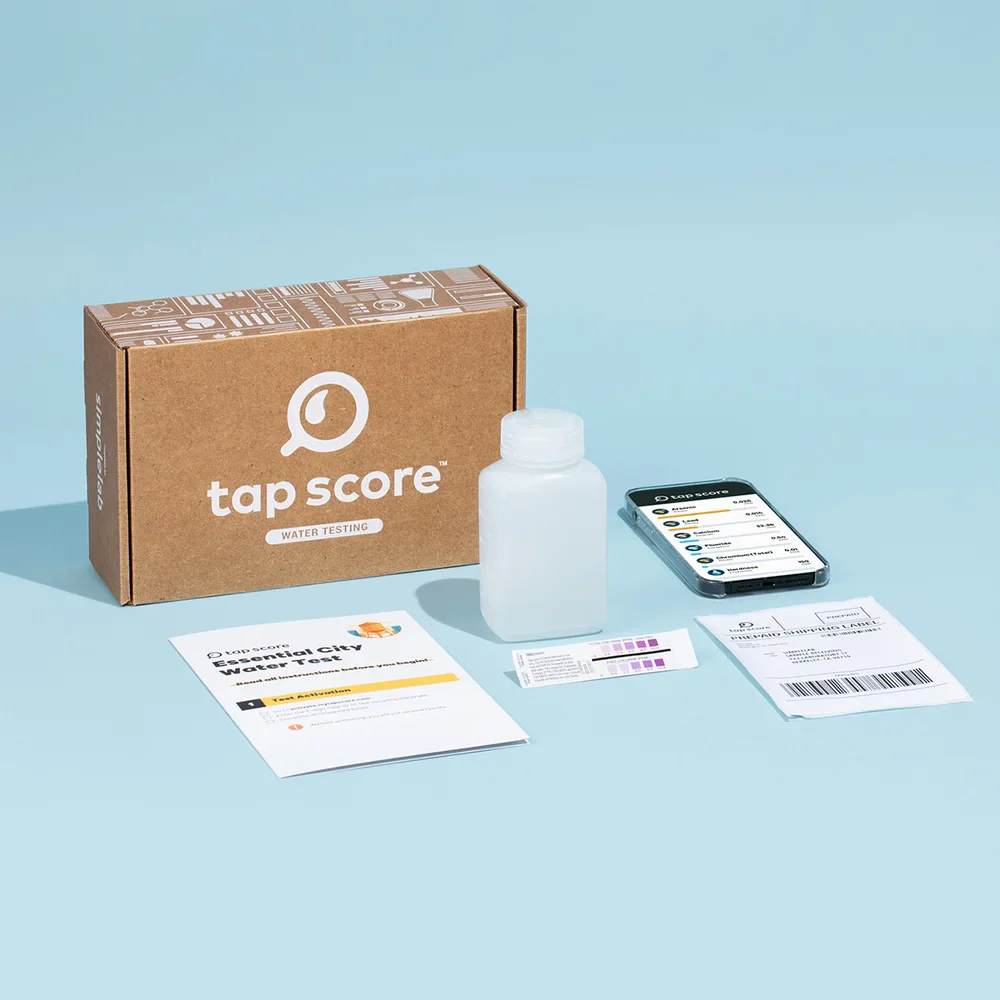
SimpleLab Tap Score — Essential City Water Test
Mail your tap water sample, get certified lab results in 5 business days. Shows exact ppb readings for lead, copper, iron, manganese, and 45 other analytes — including a written recommendation report. The test description is written for this exact situation: “primarily concerned by metals, aging pipes, and infrastructure.”
- Tests lead, copper, iron, manganese, and 45 more analytes
- Certified laboratory analysis — not a home strip test
- Results with specific ppb levels and written recommendations
- Collect from your kitchen tap — first-draw sample captures overnight pipe exposure
Don’t run the tap before collecting. Use water that has sat in your pipes for at least 6 hours — overnight is ideal. Fill the collection bottle from your kitchen tap without flushing first. This captures the highest-exposure scenario and gives the most conservative (protective) reading. SimpleLab’s kit includes instructions, but this is the most important step for lead specifically.
Step 2 — Filter Based on Your Results
Your test results will show whether you have a lead issue, a PFAS issue, or both. Here’s what the results mean for treatment:
If lead is detected above 5 ppb
The EPA’s action level is 15 ppb, but no level of lead is considered safe. At 5 ppb or above, filtering at the drinking tap is recommended. Two options:
- NSF 53-certified pitcher filter — the Clearly Filtered pitcher is NSF 53 certified for lead reduction. Lowest cost, no installation. Right for renters.
- Under-sink RO system — removes lead plus PFAS simultaneously. The Frizzlife PD600-TAM3 and SimPure T1-400ALK both handle lead and PFAS in one system. Right for homeowners. See the North Alabama installation guide for the specific gotchas in older Huntsville homes — including the 1/2-inch angle stops common in pre-1990 plumbing.
If PFAS is the primary concern (no elevated lead)
An under-sink RO system handles PFAS regardless of lead results. Huntsville’s 22.5 ppt total PFAS warrants an RO for drinking water for all Huntsville Utilities customers. The lead test helps you understand whether you’re dealing with one problem (PFAS only) or two (PFAS plus internal pipe lead).
If results are clean
You’re still on Huntsville Utilities water with PFAS above the EPA MCL. An RO system at the drinking tap remains a reasonable precaution. But at least you know your home’s internal plumbing isn’t adding to the problem.
In my time working in North Alabama water treatment, the question I get most often in neighborhoods like Twickenham and Five Points is “is our water safe?” The honest answer is: your utility water meets all federal standards, but federal standards allow some lead exposure that scientists consider harmful. For homes with original plumbing, testing is not paranoia — it’s the only way to actually answer the question for your specific address.
What You Don’t Need
To be direct about a few things that get oversold to historic home owners:
- You don’t need a water softener. Huntsville Utilities delivers water at 4.7 GPG — soft. Dealers selling softeners in historic Huntsville neighborhoods are solving a problem these homes don’t have.
- You don’t need whole-house lead filtration. Lead exposure from drinking water primarily comes from the first draw from your kitchen tap. Filtering at the drinking and cooking tap is sufficient for most households.
- You don’t need to replace your plumbing before testing. Test first. If results are clean, you may have little or no exposure issue despite the home’s age.
Frequently Asked Questions
Is Twickenham Huntsville water safe to drink?
Huntsville Utilities meets all federal standards and confirmed zero lead service lines in its 2024 inventory. However, homes built before 1986 may have lead solder in internal plumbing. The utility delivers safe water to your meter; what comes out of your tap depends on your home’s specific plumbing.
Do historic Huntsville homes have lead in the water?
Possibly. The Safe Drinking Water Act banned lead solder in 1986. Most of Twickenham and Five Points predates this. The only way to know for your specific home is to test the water at your tap. A first-draw sample (water that sat overnight in your pipes) will show the highest-exposure reading.
What water test should I get for a historic Huntsville home?
The SimpleLab Essential City Water Test ($189) is designed specifically for aging pipes and infrastructure — 49 analytes including lead, copper, and iron, with results in 5 business days and a written recommendation report.
Does Huntsville water have PFAS?
Yes. Huntsville Utilities’ 2025 CCR shows 22.5 ppt total PFAS, with PFOS at 7.6 ppt and PFOA at 4.2 ppt — both above the EPA’s 4 ppt MCL. An under-sink RO system removes PFAS at the drinking tap.
Disclosure: North Alabama Water Guide earns a commission on purchases through links on this page. Data from Huntsville Utilities 2025 Consumer Confidence Report, EPA Lead and Copper Rule, and Safe Drinking Water Act records. See our full affiliate disclosure.