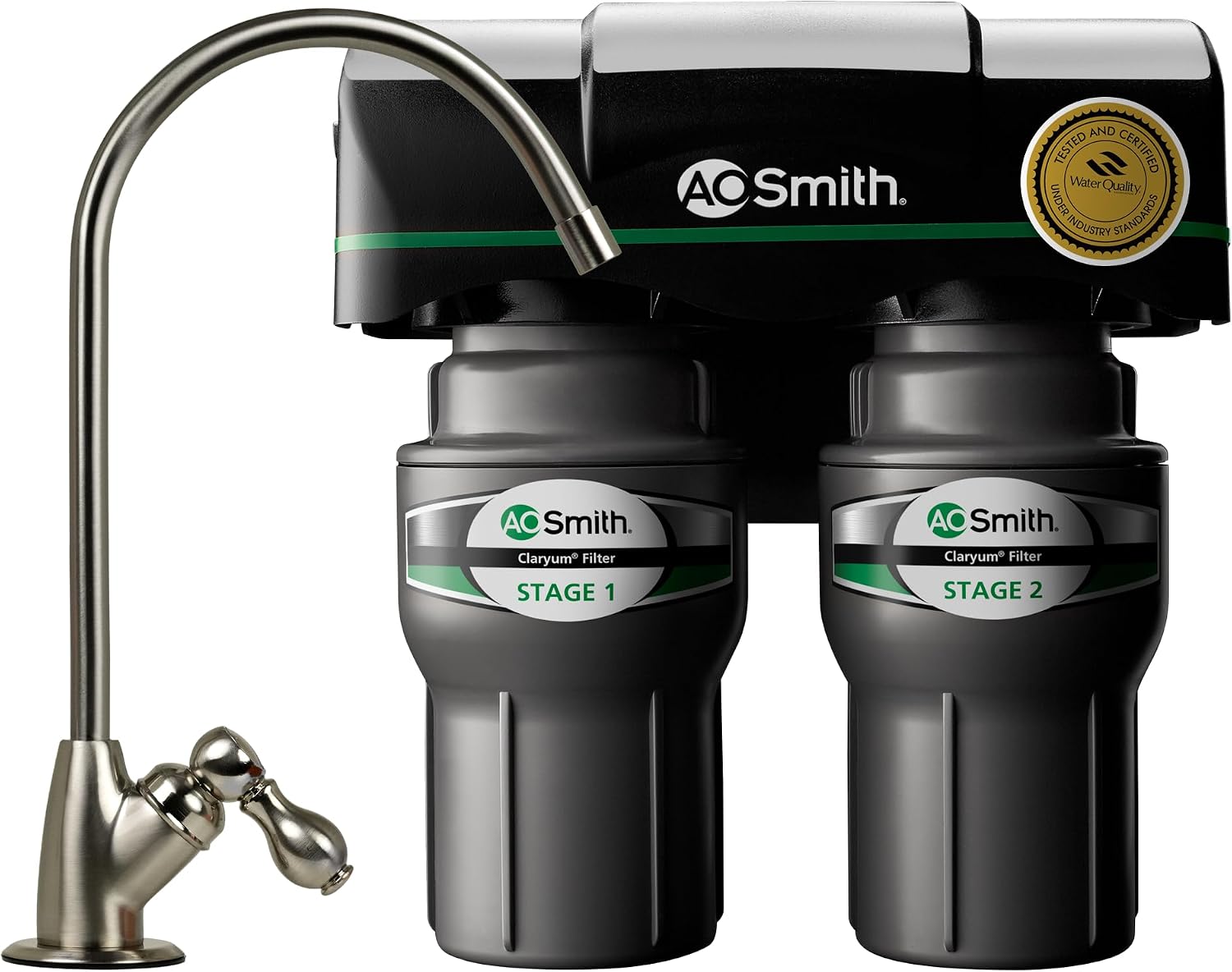
AO Smith AO-US-200 — 2-Stage Claryum® Under-Sink Filter
Why This Filter Is Relevant in North Alabama
Most under-sink filters are certified to NSF/ANSI 42 — taste and odor only. The AO-US-200 adds NSF/ANSI 53 (health contaminants including lead and cysts) and NSF/ANSI 401 (emerging contaminants, the standard that covers PFAS compounds). That certification set matters specifically for the Tennessee Valley.
Huntsville Utilities’ 2025 Consumer Confidence Report shows total PFAS at 22.5 ppt, with PFOS at 7.6 ppt and PFOA at 4.2 ppt — both above the EPA’s new 4 ppt MCL. In May 2026, Huntsville Utilities filed suit against 3M, DuPont, Chemours, BASF, Daikin, and North Alabama industrial operators, alleging PFAS contamination of the Tennessee River supply and claiming damages for filtration upgrades. The utility stated that water is currently safe under existing regulations but acknowledged that treatment will need upgrading as standards tighten.
The AO-US-200 sits between two better-known options: above the Brita and ZeroWater pitchers that don’t carry NSF 401, and below under-sink reverse osmosis systems that are more thorough but significantly more involved. It is a coherent product for a specific buyer — and an inappropriate one for several others.
The AO-US-200 is WQA certified to NSF/ANSI 401, and the replacement cartridge listing at FiltersFast adds NSF P473 — the protocol specifically for PFOA and PFOS. Before purchasing if PFAS removal is your primary reason: scan the QR code on the Performance Data Sheet in the manual, or search AO-US-200 at wqa.org, to confirm which specific PFAS compounds are certified and at what percentage reduction. The retail bullet point list and the certified list are not always identical in this category.
Which Huntsville Water You’re On Changes the Math
Huntsville Utilities draws from two fundamentally different sources depending on your address — and almost nobody knows which one serves their tap.
| Source | Hardness | Character | Filter Life Expectation |
|---|---|---|---|
| Tennessee River surface water South Parkway, Southwest, Southeast WTPs |
65–75 mg/L (3.8–4.4 GPG) | Comparatively soft, chlorinated, PFAS present | 500-gallon rating realistic — best case for this filter |
| Limestone aquifer groundwater Lincoln-Dallas, Williams Well |
160–170 mg/L (9.4–9.9 GPG) | Much harder, same PFAS risk, calcium precipitates when heated | 6-month calendar interval will bind before 500 gallons — flow drops noticeably toward end |
To find which source serves your address: call Huntsville Utilities Water Quality Lab at 256-650-6374 or email waterlab@hsvutil.org. This is worth knowing before deciding on this filter vs an RO system, since the harder groundwater supply accelerates cartridge depletion significantly.
Who Should Buy the AO-US-200
Your water is comparatively soft (65–75 mg/L), chlorinated, and the 401 certification addresses your documented PFAS concern directly. The 500-gallon rating is realistic on this supply. This is the profile where the AO-US-200 makes the most sense.
No wastewater. No pressure pump. No storage tank. Installs in 30–45 minutes. If you’ve been using a Brita and want meaningful PFAS certification without full RO complexity, this is the step up.
Wall mounts with two screws, dedicated faucet needs a 1/2-inch hole. The included brushed nickel faucet covers most kitchen finishes. All hardware included — no plumber required.
Decatur Utilities uses chlorine (not chloramine). Current PFAS results are below the EPA MCL at 3.1 ppt PFOS, 2.2 ppt PFOA. If you want incremental PFAS reduction above what you’re already getting, the AO-US-200 is a lower-cost option than RO. Verify the P473 listing first.
Wall mounts with screws, dedicated faucet needs a drilled hole. None of this is reversible. For renters: the Dreo WF511 countertop RO ($144.49) or AquaTru Classic require zero installation.
The manual explicitly states: must not be used with water that is microbiologically unsafe or of unknown quality without adequate disinfection. Test your well first. If bacteria or heavy iron are present, treat those before any point-of-use filter.
That’s hardness. No under-sink drinking water filter addresses it. Hardness is a whole-house problem. See the water softener guide for the actual solution.
If chlorine taste is your only complaint, NSF/ANSI 42 solves it. Paying $129 plus $150/year for 401 PFAS certification you don’t need is poor value. A high-capacity single-cartridge NSF 42 filter runs $45–$70 with a 16,000-gallon cartridge.
The 500-Gallon Trade — Understanding the Real Cost
The capacity is the honest limitation at the center of this product. You are buying breadth of certification — three NSF standards covering 78+ contaminants — and paying for it in gallons per cartridge. A competitor certified only to NSF/ANSI 42 might offer 16,000+ gallons for the same cartridge price. The math:
| Cost over 5 years | AO-US-200 | High-capacity NSF 42 filter | Under-sink RO |
|---|---|---|---|
| Hardware | $129 | $45–$70 | $300–$400 |
| Annual cartridge cost | ~$154 (2 × $76.95) | ~$30–$50 | ~$60–$100 |
| 5-year total (estimated) | ~$900 | ~$250–$320 | ~$650–$900 |
| PFAS certified? | Yes (NSF 401 / P473) | No (NSF 42 only) | Yes (NSF 58) |
The AO-US-200 costs roughly the same over five years as an under-sink RO. The RO removes more contaminants. The AO-US-200 is simpler to install and produces no wastewater. If budget is the constraint, it is meaningfully more expensive than a taste-only filter. The value proposition is specifically the certification set — not the price per gallon.
AO-US-200 vs the Alternatives
| Factor | AO-US-200 | Frizzlife PD600-TAM3 (RO) | Brita / ZeroWater (Pitcher) |
|---|---|---|---|
| NSF certification | 42 + 53 + 401 | NSF 58 + 372 | 42 only (Brita) / 42+53 (some ZW) |
| PFAS removal | Yes — NSF 401 / P473 | Yes — RO membrane | No (standard pitchers) |
| Chloramine removal | Yes (CTO carbon) | Yes (TAM3 stage) | Limited |
| Installation | Under-sink, drill hole, 30–45 min | Under-sink, more complex | None |
| Wastewater | None | 3:1 drain ratio | None |
| Flow rate | 0.5 GPM dedicated faucet | 600 GPD tankless | Batch process |
| Cartridge life | 500 gal / 6 months | 12–24 months | 40–150 gal / 2–6 months |
| 5-year cost | ~$900 | ~$650–$900 | ~$150–$300 |
| Retains minerals | Yes | No (RO removes minerals) | Yes |
✓ Where the AO-US-200 wins
- Triple NSF certification (42+53+401) is stronger than most competitors at this price
- No wastewater — advantage over all RO systems
- Retains beneficial minerals — no flat RO taste
- Simpler install than RO
- Full install kit included — no plumber needed
- WQA certified — third-party verified, not just manufacturer claims
✗ Where it loses
- 500 gallons / 6 months is the shortest rated life in this category
- ~$154/year cartridge cost — expensive relative to capacity
- Dedicated faucet at 0.5 GPM only — slower than tankless RO
- Less PFAS removal than RO
- Cannot be used on well water without pre-treatment
- Not suitable for renters
Installation in North Alabama Homes — What to Know First
- Older Huntsville homes (pre-1990) often have 1/2-inch angle stops — the AO-US-200 brass tee connects to a standard cold water supply line. Check your angle stop before ordering; if it’s a non-standard size, pick up an adapter at Lowe’s on the same trip.
- Granite and quartz countertops (common in Madison and newer Huntsville homes) require a diamond hole saw for the 1/2-inch faucet hole. Lowe’s on University Drive or Home Depot in Madison carries them. Drill slowly with water cooling the bit.
- Do not plug into the garbage disposal outlet — that is a switched outlet. The filter’s LED alarm needs a standard always-on 110V outlet.
- Flush 10 minutes before drinking — new Claryum® carbon blocks shed fines that turn the water gray initially. Flush to clear, then confirm water runs clear before using.
- Operating pressure 20–80 psi — most Huntsville and Madison municipal supplies run 45–75 psi, well within range. If you’re on a rural Limestone or Morgan County line, verify pressure during peak hours.
- Replace housing every 5 years — the manual explicitly warns that failure to replace the housing creates a risk of property damage from leaks. Diary this now.
In May 2026, Huntsville Utilities filed suit against 3M, DuPont, Chemours, and others, alleging PFAS contamination of the Tennessee River supply and seeking damages for filtration upgrades. The utility stated that current water is compliant and safe to drink, but acknowledged that standards are tightening and upgrades will be needed. This regulatory backdrop is relevant for any North Alabama household deciding whether to filter now: the utility is telling you it is considering RO treatment at utility scale for the same contaminants this filter addresses at the tap. Acting at the household level in the meantime with an NSF 401-certified system is a reasonable response to a confirmed, not hypothetical, regional contamination story.
The AO-US-200 earns its place in a North Alabama filter lineup for one specific buyer: a Huntsville or Madison homeowner on the softer Tennessee River surface water supply who wants credible PFAS certification without RO installation complexity. The NSF 401 certification is real and the WQA mark is third-party verified — this isn’t marketing copy, it’s documented performance. The 500-gallon cartridge is the price you pay for that certification breadth. Know it going in, budget $154/year for cartridges, and verify the P473 listing on the performance data sheet before purchasing if PFAS is your primary reason.
Questions to Ask Before You Buy
Ask A. O. Smith (support line in the manual)
- Is the AO-US-200 certified to NSF P473 for PFOA and PFOS reduction, and where is that listing published?
- What percentage reduction is certified for PFOA and PFOS, and at what influent concentration?
- Does one AO-US-200-R two-pack service the system once or twice — is it a 6-month or 12-month supply?
- Is chloramine among the certified reduction claims, or only chlorine?
Ask Huntsville Utilities (256-650-6374)
- Is my address served by surface water or groundwater?
- What is the hardness at my address, in mg/L?
- What were the most recent PFAS results for the plant serving me?
Frequently Asked Questions
Does the AO Smith AO-US-200 remove PFAS?
It is WQA certified to NSF/ANSI 401, which covers emerging contaminants including PFOA and PFOS. The replacement cartridge at FiltersFast additionally lists NSF P473. Verify the Performance Data Sheet QR code in the manual or check wqa.org for the confirmed certified reduction percentages before purchasing.
Is it good for Huntsville Alabama water?
Yes, especially for households on Huntsville’s softer surface water supply (65–75 mg/L). NSF/ANSI 42+53+401 covers chlorination taste and odor, health contaminants, and PFAS — the documented concerns for Tennessee River water. On the harder groundwater supply, expect shorter effective cartridge life.
How long do the filters last in North Alabama?
500 gallons or 6 months, whichever comes first. For a typical household drawing 2–3 gallons per day from the dedicated faucet, the 6-month calendar interval will usually bind first. On the harder groundwater blend, flow may drop noticeably toward the end. Budget two AO-US-200-R packs ($76.95 each) per year.
AO Smith vs Frizzlife PD600 — which is better for North Alabama?
The Frizzlife PD600-TAM3 is a full RO system (more thorough PFAS removal), higher flow rate (600 GPD vs 0.5 GPM), and longer cartridge life. It costs about $100 more upfront and produces wastewater. The AO-US-200 is simpler to install, wastes no water, and retains minerals. For maximum PFAS removal: Frizzlife. For simpler installation and no wastewater: AO-US-200.
Where is the AO-US-200 sold in North Alabama?
Lowe’s is the primary retail channel — the manual directs owners to aosmithatlowes.com. Lowe’s stores in Huntsville, Madison, and Decatur carry the line. Also available on Amazon.
Disclosure: North Alabama Water Guide earns a commission on purchases through links on this page. Prices observed August 2026. Data from A. O. Smith AO-US-200 Owner’s Manual (AO-US-200_install_Jun2025), WQA certification database, Huntsville Utilities Water Quality Lab, and the May 2026 WHNT/WAFF reporting on Huntsville Utilities’ PFAS litigation. See our full affiliate disclosure.