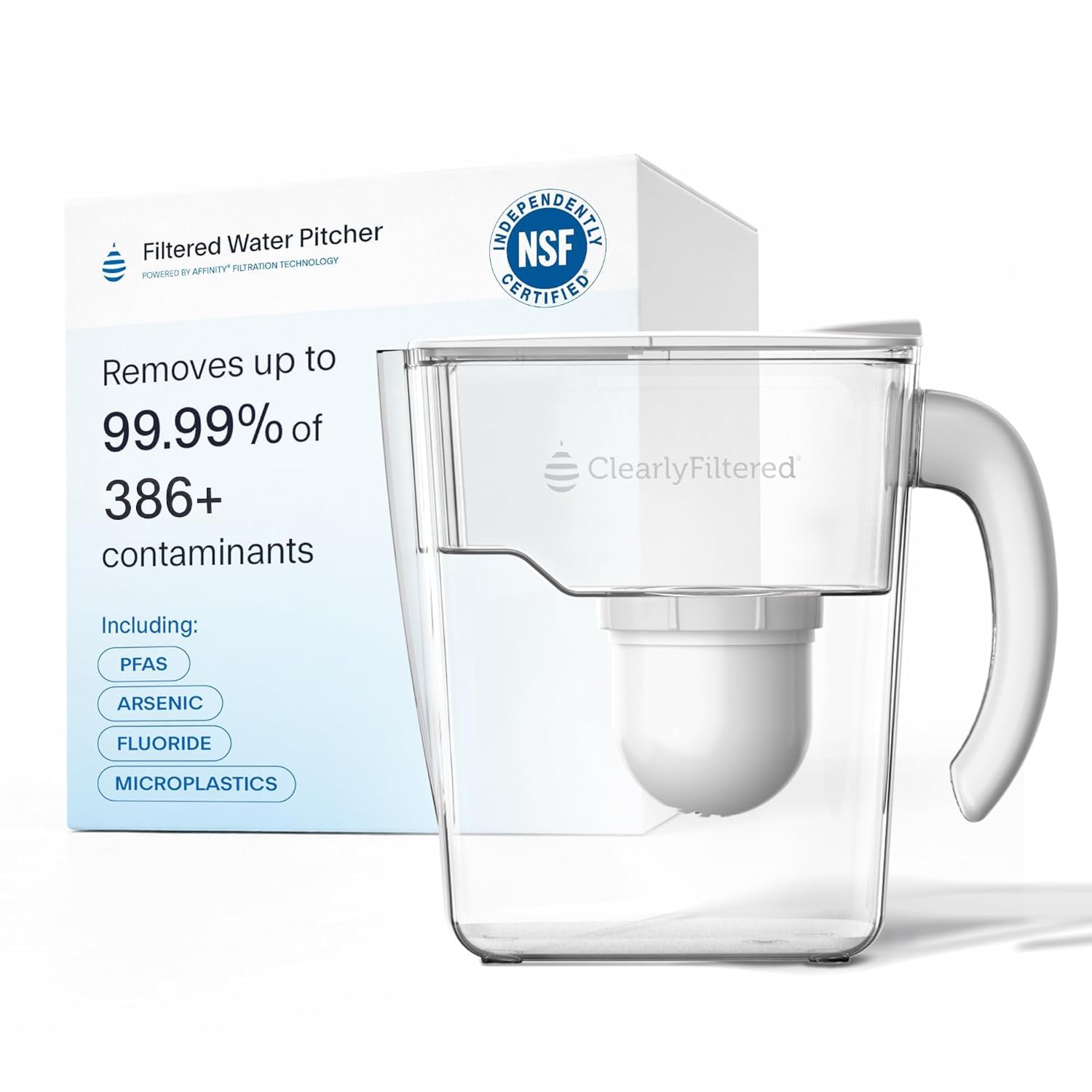
Clearly Filtered Water Filter Pitcher
The North Alabama Context
Huntsville Utilities’ 2025 Consumer Confidence Report shows PFOS at 7.6 ppt and PFOA at 4.2 ppt — both above the EPA’s 4 ppt MCL. LCWSA (Limestone County) is worse at 11.0 ppt PFOS. Most pitcher filters — including standard Brita and ZeroWater models — are not certified to remove PFAS at all. The Clearly Filtered pitcher is the exception.
But certification has limits, and understanding them matters for North Alabama buyers specifically. The NSF/ANSI 53 acceptance level for PFAS is 20 ppt — not the EPA’s 4 ppt. At Huntsville’s 7.6 ppt PFOS, the pitcher will reduce exposure. Whether it gets you consistently below 4 ppt is a different question. That honest framing is what this review is built around.
Renters who can’t install under-sink plumbing. Homeowners who want a meaningful step up from a Brita before committing to an RO system. Anyone already using an uncertified pitcher for PFAS who needs to understand what they actually have. This review explains what the Clearly Filtered pitcher does, what it can’t do, and when a different tool is the right answer.
What Makes It Different from Standard Pitchers
Affinity filtration vs standard carbon
Most pitchers use granular activated carbon (GAC) — coconut shell or coal-based carbon in loose granule form. GAC handles chlorine, taste, and odor well. PFAS removal is inconsistent and unverified in most GAC pitchers. The Clearly Filtered pitcher uses what the company calls affinity filtration — a multi-media system combining activated carbon with ion exchange media and other layers, specifically engineered to attract and bind PFAS molecules. The result is third-party verified performance rather than claimed performance.
The certification difference
When a pitcher label says “NSF certified,” it almost always means NSF/ANSI 42 — taste and odor only. The Clearly Filtered pitcher carries NSF/ANSI 53, which covers health-related contaminants including lead, and specifically includes PFOA and PFOS in its certification scope. This is the standard that matters for PFAS. See our full PFAS pitcher certification guide for the complete breakdown of what each standard covers.
NSF/ANSI 53 requires PFAS reduction to an acceptance level of 20 ppt — not the EPA’s 4 ppt MCL. This means a filter can pass NSF 53 certification while its output still exceeds the EPA limit. With Huntsville’s PFOS at 7.6 ppt, a certified Clearly Filtered pitcher will reduce it. Whether every fill is below 4 ppt depends on water flow rate, cartridge age, and PFAS compound mix — none of which you can control precisely. This limitation applies to every PFAS-certified pitcher, not just Clearly Filtered.
Performance Ratings for North Alabama Water
Based on certified performance data and independent testing. Chloramine rating reflects that pitcher contact time is shorter than under-sink systems — adequate but not optimal for Huntsville’s post-2021 chloramine supply.
Pros and Cons
✓ Strengths
- NSF/ANSI 53 with explicit PFAS claim — verified, not claimed
- 365+ contaminants targeted vs ~40 in standard pitchers
- Removes fluoride (most pitchers don’t)
- Removes arsenic (most pitchers don’t)
- Reduces microplastics
- BPA-free medical-grade Tritan construction
- 80 oz (10 cups) — adequate for a household
- No installation — renters can use it
✗ Limitations
- $108.49 upfront — 2.5x the cost of a Brita Elite
- $185/year in filters — comparable to a low-end RO system
- 100-gallon/4-month filter life is short vs some competitors
- NSF 53 ceiling is 20 ppt — not guaranteed sub-4 ppt output
- Gravity filtration is slow vs tap-connected filters
- Priming required — initial gray water runoff before first use
- Only treats water you pour through it — not cooking or ice maker
The Replacement Filter Cost — Honest Math
5-Year Total Cost Comparison
The Clearly Filtered pitcher costs more than an under-sink RO system over five years — while providing less PFAS removal. This doesn’t make it a bad product, but it does mean it’s the right choice for specific situations rather than a universal recommendation. If you can install an under-sink filter, the RO gives you more for less money long-term.
How It Compares to Other Pitchers
| Pitcher | PFAS certified? | Fluoride? | Arsenic? | Filter life | Price |
|---|---|---|---|---|---|
| Clearly Filtered | Yes — NSF 53 | Yes | Yes | 100 gal / 4 mo | $108 + $185/yr |
| Brita Elite | NSF 53, verify PFAS claim | No | No | 120 gal / 2 mo | ~$40 + $84/yr |
| ZeroWater | NSF 53 + P473 | Partial | No | 25–40 gal | ~$40 + $150+/yr |
| Brita Standard | No | No | No | 40 gal / 2 mo | ~$30 + $50/yr |
| PUR Plus | No explicit PFAS claim | No | No | 40 gal / 2 mo | ~$35 + $60/yr |
Verify all certifications at info.nsf.org before purchasing. Certification claims change. The Brita Elite’s NSF 53 status should be confirmed for an explicit PFAS reduction claim specifically — not all NSF 53 certifications include PFAS.
Who Should Buy It
✓ Best fit for the Clearly Filtered pitcher
- Renters in Huntsville, Madison, or Limestone County who can’t install under-sink plumbing and want meaningful PFAS reduction beyond an uncertified pitcher
- Homeowners considering an RO system but not ready to commit — the Clearly Filtered pitcher is a legitimate interim solution while you evaluate under-sink options
- Anyone currently using a standard Brita or ZeroWater and assuming it removes PFAS — it almost certainly doesn’t, and this is the upgrade that actually does
- Households with older children or pregnant women where any reduction in PFAS exposure matters, even if it doesn’t reach sub-4 ppt
- Office or small business use where installing a plumbed-in filter isn’t practical
✗ Probably not the right choice if
- You’re a homeowner who can install an under-sink filter — a Frizzlife PD600-TAM3 or Waterdrop X12 gives you better PFAS removal for less money over 5 years
- Your primary concern is LCWSA water at 11 ppt PFOS — at that level, sub-4 ppt output from a pitcher is even less reliable
- You have well water with bacteria, iron above 1 ppm, or high sediment — address those problems first; the pitcher isn’t designed for microbiological contamination
The Replacement Filter Pack
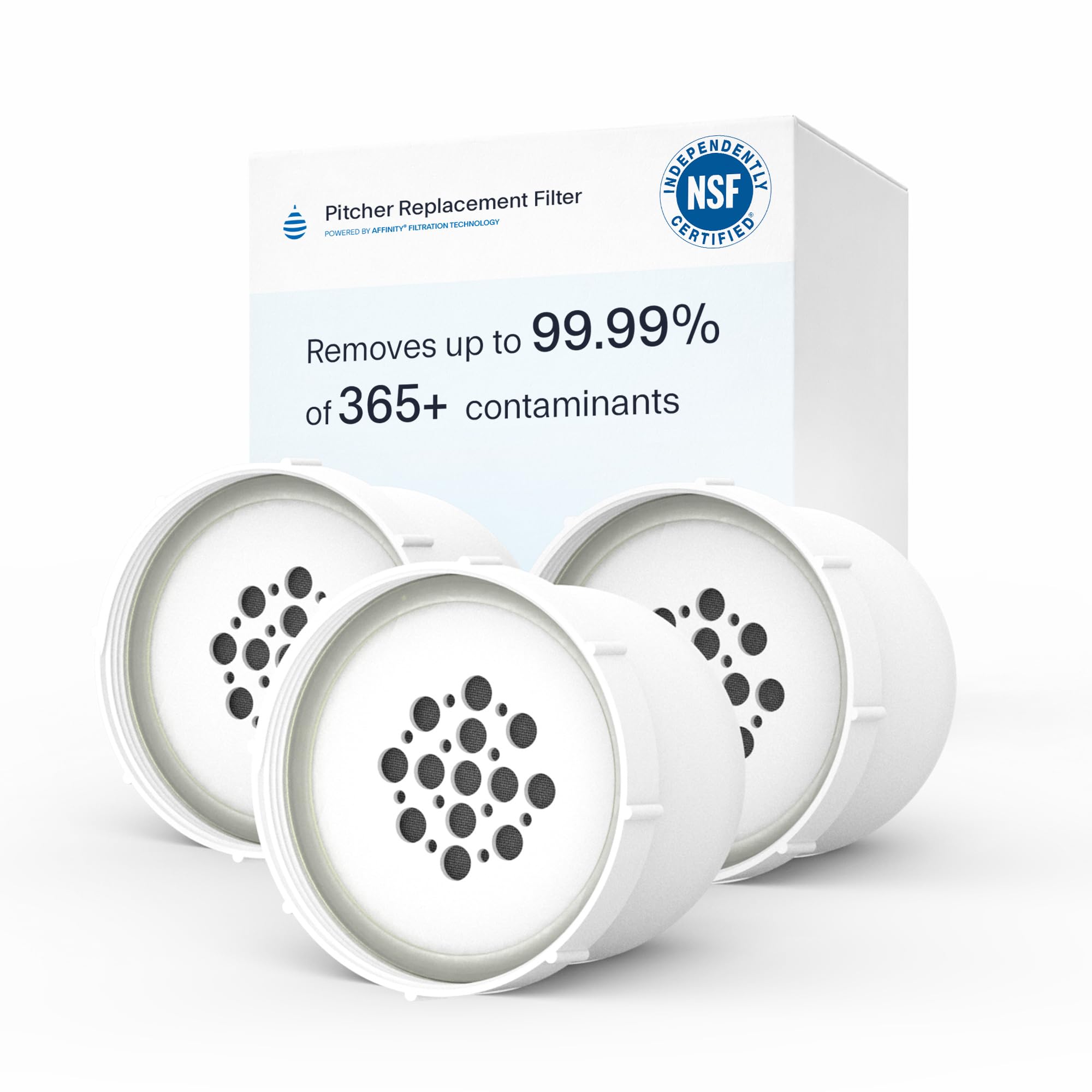
Clearly Filtered Replacement Filters — 3-Pack
One 3-pack covers roughly a year at the recommended 4-month replacement interval. The replacement filters carry a higher rating (4.6 vs 4.1) than the pitcher itself — consistent performance is where most of the satisfaction comes from. Don’t push past 4 months or 100 gallons: an exhausted filter’s PFAS removal drops off, and a severely exhausted carbon filter can release contaminants back into the water.
Buy Replacement Filters 3-Pack →Pennsylvania DEP explicitly warns that pushing past the replacement date on PFAS-certified filters can increase PFAS exposure risk — the exhausted carbon can desorb contaminants back into the water. Set a calendar reminder for 4 months from installation. If you’re on well water with high sediment or iron, check flow rate monthly and replace early if filtration visibly slows.
When to Use RO Instead
If you are a homeowner in Huntsville on Huntsville Utilities water and can install an under-sink filter, the Frizzlife PD600-TAM3 is a better choice. It costs less over 5 years, removes PFAS more completely (RO membrane vs certified-to-20-ppt carbon), handles Huntsville’s chloramine with a CTO pre-filter specifically designed for it, and filters at tap speed rather than gravity speed. The only advantage the Clearly Filtered pitcher has for a homeowner is zero installation.
Frequently Asked Questions
Does the Clearly Filtered pitcher remove PFAS?
Yes — it is NSF/ANSI 53-certified with an explicit PFAS claim. It reduces PFOA, PFOS, and other PFAS compounds. The certified acceptance level is 20 ppt, not the EPA’s 4 ppt MCL. For Huntsville at 7.6 ppt PFOS, the pitcher will reduce exposure but cannot guarantee consistent output below 4 ppt.
How long does the Clearly Filtered filter last?
100 gallons or 4 months, whichever comes first. The 3-pack replacement set ($185) covers roughly a year. Replace on schedule — an exhausted filter’s PFAS removal degrades and a severely exhausted filter can release contaminants.
Clearly Filtered vs Brita Elite for PFAS?
Clearly Filtered is stronger for PFAS, fluoride, arsenic, and microplastics. Brita Elite carries NSF 53 — verify it includes an explicit PFAS reduction claim at info.nsf.org. Clearly Filtered costs roughly twice as much upfront and more per year in filters. The difference is worth paying if PFAS is your primary concern.
Is it good for Huntsville water specifically?
It’s the best certified pitcher option for Huntsville PFAS. Whether it consistently gets PFOS below 4 ppt from Huntsville’s 7.6 ppt baseline is not guaranteed — the NSF 53 acceptance level is 20 ppt. For a renter or someone not ready for under-sink installation, it’s the right step up. For homeowners who can install a filter, an RO system is more thorough and cheaper long-term.
Does it work on well water?
For chemical reduction on treated well water, yes. Not for microbiologically unsafe well water — test your well first and address any bacterial contamination with appropriate treatment. High iron or sediment will clog the filter faster; plan for more frequent replacement.
Disclosure: North Alabama Water Guide earns a commission on purchases through Amazon links on this page using the northalabamawater-20 affiliate tag. Product data (price, ratings, specs) sourced from Amazon listing and Clearly Filtered published performance documentation, August 2026. NSF/ANSI certification data verified at info.nsf.org. See our full affiliate disclosure.